Did your kid touch a hot stove? Run away from you at a park? Had an outburst when playing with a friend? Or are they forgetting to pay attention to their body to eat when they’re hungry or use the restroom? Oftentimes when we tell our BCBAs about this concern, we’re told to write a social story. And oftentimes, we go home from ABA with a stack of crayon-and-paper stories that our BCBAs and RBTs wrote for the day. But without the right training, one may wonder, what is the point?
So if you are asking, “Do social stories help autistic children?”, know that the newest research gives a nuanced answer: yes, often for specific, concrete situations, especially when the story is personalized, accurate, repeated over time, and paired with visuals or other supports.
Let’s cite some actual, medical research – not a reddit board or Facebook group. Sure, it’s a bit boring, but it helps you understand the why behind the what. In a recent study from the Journal of Autism and Developmental Disorders, social story approaches were associated with better preparation for eye exams, improved communication and lower anxiety in a small child trial, stronger understanding of friendship-related social norms in adolescents, and better self-set goal attainment in autistic adults using digital stories.
One huge caveat to social stories: it comes down to context. A generic story about an incident that may or may not be relatable to your kiddo don’t really work. Stronger examples of social stories:
- are descriptive more than directive;
- include meaningful titles;
- use accurate step-by-step information;
- preview sensory experiences;
- give the child realistic coping options;
- and allow customization.
Why social stories matter for autistic children and the adults supporting them
The research is clear: Social stories matter most when an autistic child needs help making sense of a situation that is predictable, stressful, unfamiliar, or socially loaded. That includes medical visits, friendship moments, communication breakdowns, and anxiety-provoking routines. Recent open-access work from researchers at University of Guelph and University of Bath highlights a common thread: social stories are most promising when they make the child’s next steps clearer, more concrete, and easier to rehearse.
And this is why you get paper-and-crayon stories from your therapist or school, and why they ask you to read them to your kiddos. They are relatively light-burden, easy to revisit, and adaptable across home, school, and healthcare settings.
What the newest medical research says about benefits and outcomes
Ready to dive deeper and feel smart? Here’s some of the latest research on the impact of social stories:
- Venkatesh et al. 2025 Social Story Eye Exam Study
Population: 30 children (ages 5–10) with mild-to-moderate autism
Outcome: Readiness for eye examinations
Findings: Social Story–based preparation significantly improved testability, with children 2x more likely to successfully complete exams. Individual test success odds ranged from 1.96 to 3.89x higher.
Why it matters: Strong evidence that social stories work well for specific, predictable situations like medical visits.
- Rodrigues da Silva & Mwangi 2025 Social Stories Communication Study
Population: 30 children (ages 6–10) with autism
Outcome: Communication skills and anxiety
Findings: Ten weeks of individualized social stories led to significant communication improvements and reduced anxiety, with effects lasting 5 months post-intervention.
Why it matters: Suggests social stories can support emotional regulation + communication, not just compliance.
- Costescu et al. 2025 Digital vs Traditional Social Stories Study
Population: 3 adolescents (ages 10–12) with autism
Outcome: Understanding social norms (friendship)
Findings: All participants improved, and digital social stories performed just as well as printed ones (no significant difference).
Why it matters: Validates digital delivery as equally effective—not a downgrade.
- Dobson et al. 2025 Social Stories Content Analysis Study
Population: 82 publicly available social stories
Outcome: Quality and implementation readiness
Findings: Most stories included evidence-based elements (clear steps, coping strategies), but only 26% were customizable.
Why it matters: Personalization is a major gap in real-world social story use—and a critical success factor.
- Zafar et al. 2025 Social Stories Clinical Use Study
Population: Pediatric and special-care dentistry specialists
Outcome: Perceived usefulness in clinical settings
Findings: Social stories were widely seen as helpful, but effectiveness perception dropped with higher support needs (94% → 44%).
Why it matters: Social stories work best when properly adapted to the child’s level—not one-size-fits-all.
- Camilleri et al. 2025 Digital Social Stories Self-Determination Study
Population: 33 autistic adults
Outcome: Goal attainment and self-determination
Findings: Digitally mediated social stories produced a statistically significant improvement in goal progress, with a large effect size in just 2 weeks.
Why it matters: Shows social stories aren’t just for kids—they support independence and executive function.
Now here’s the TLDR: Social story outcomes are real but usually narrow: preparation, coping, comprehension, communication, and goal progress rather than sweeping changes in all social-emotional functioning. Second, digital delivery looks viable, because newer studies did not show digital formats to be inferior and in some cases showed clear gains. Third, fit matters: the child’s support needs, the scenario, the story quality, and the consistency of adult use all appear to shape outcomes.
How to write and use social stories well
- Start with one precise situation, not a vague goal. “Getting a blood draw,” “losing a game,” “moving from tablet time to dinner,” or “starting an eye exam” are better targets than “behave better” or “improve social skills.”
- Personalization matters. Stories should reflect the child’s communication style, sensory preferences, vocabulary level, and actual environment. They should be descriptive more than directive, factually accurate, and specific about sensory or procedural details. They also work better when they give the child realistic choices, such as who can stay nearby, what coping strategy to use, or what words to say if they need help.
- Use matters as much as writing. Do not read a social story once and expect magic. Preview it before the event, repeat it in calm moments, use the same wording across adults, and revisit it after the event to update what worked.
- The implementation challenges are equally important. Unfortunately, most publicly available social stories are not customizable. Social stories work best when they are accurate, individualized, repeated, and integrated into a broader support plan.
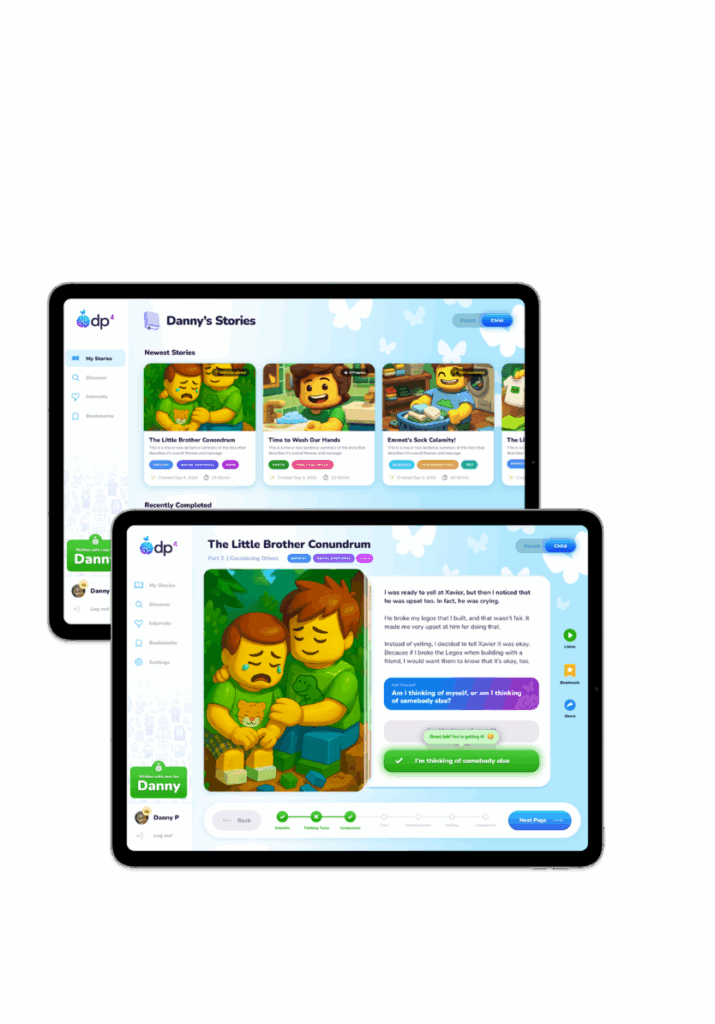
Here’s an example from DP4 – in this situation, the kiddo threw a fit when he was about to lose at Candyland. As you can see in this social story, the situation is highly specific to the situation that occurred, who was there, and what the kiddo’s reaction was. It provides the replacement behavior, and gives the kiddo a chance to try out the replacement behavior in a new scenario.
Your turn: How you can use DP4
The best use cases for social story templates are the ones that are concrete, stressful, and repeatable. That is where social stories appear most helpful and where DP4’s personalization features are the strongest practical match.
- Starting an eye exam
“Billy has an eye doctor appointment this week. At the last visit, he refused to sit in the chair and got overwhelmed by the lights and machines. Help him understand what each step will be like and what they can do if something feels uncomfortable.” - Losing a game and staying a good friend
“Mary lost at Mario Kart to her friend today and she threw the game piece at her. She then ran out of the room and cried for a long time. We had to leave our playdate early.” - Transitioning off a favorite screen activity
“Last night, Kayte screamed and dropped to the floor when I said time was up for the ipad. I used the first-then scenario, but it didn’t work.” - Big problem, little problem, and asking for help
“Amay got very upset this morning because their toast was cut the wrong way. Help them learn the difference between a big problem and a little problem, name the feeling, and give them simple words they can use to ask for help instead of melting down.”
If you are a parent or educator who keeps explaining the same transition, routine, meltdown, medical visit, or friendship problem over and over, the DP4 Beta is worth a look. We’re here to help you turn the messy moments into meaningful outcomes. And we’d love to learn how it works for you!